Introduction
Most internship advice online focuses on writing the "perfect resume" or using buzzwords that supposedly impress recruiters. The reality is very different.
At startups, hiring decisions are often made by founders, small teams, or hiring managers who are juggling multiple responsibilities at once. They don't have hours to review every application. They are looking for signals that show initiative, problem-solving ability, and genuine interest.
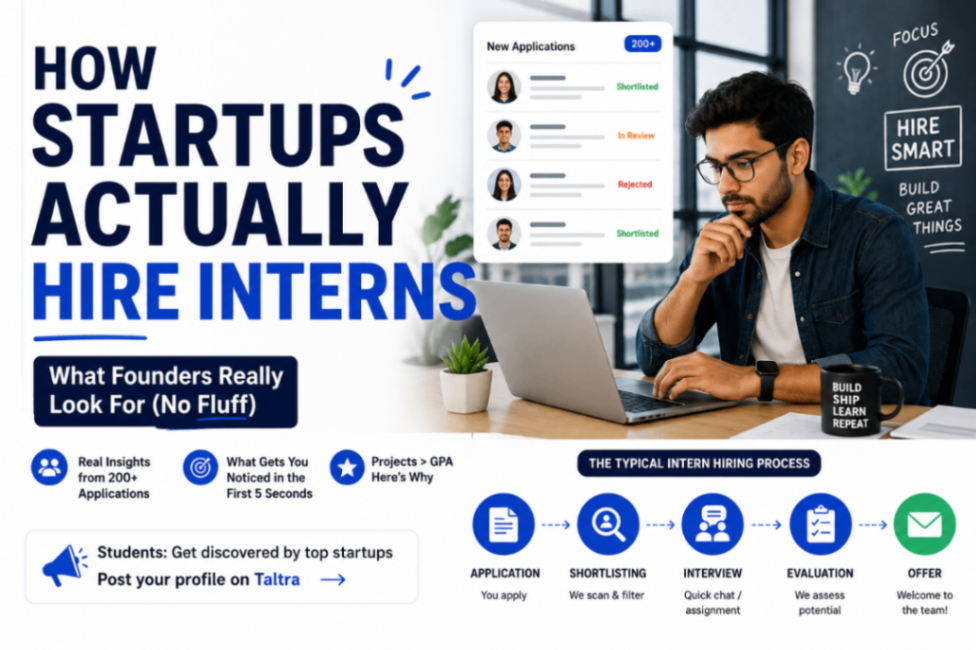
At Taltra, after reviewing hundreds of internship applications across various hiring cycles, one thing became clear: most students are not rejected because they lack experience. They are rejected because they fail to stand out.
If you're wondering how to get a startup internship in India, understanding how founders actually evaluate candidates can dramatically improve your chances. This guide reveals the real intern selection process used by startups and explains what students can do to get noticed.
Why Startup Internship Hiring Is Different
Unlike large corporations that follow structured recruitment processes, startups hire based on potential, adaptability, and execution.
Founders are not looking for candidates with perfect GPAs or lengthy resumes. They're looking for people who can learn quickly, take ownership, and contribute from day one.
This means students from Tier 2 and Tier 3 colleges often have an equal opportunity to compete if they demonstrate the right skills and mindset.
What a Startup Founder’s Inbox Actually Looks Like
When a startup posts an internship opening, applications start pouring in almost immediately.
Within a few days, founders may receive dozens or even hundreds of applications. Most of these applications follow the same pattern:
- Generic cover letters copied from the internet
- Resumes filled with buzzwords but no practical work
- Applications for roles unrelated to the candidate’s skills
- No portfolio, projects, or work samples
Only a small percentage of applicants actually stand out.
The good news?
You're not competing with every applicant. You're competing with the few candidates who genuinely put effort into their application.
The 5-Second Rule: How Startups Screen Applications
Most startup founders don't read applications in detail during the first review.
They scan.
Within seconds, they decide whether to continue reading or move on.
What Gets Attention
A personalized opening message
A project or portfolio link
A clean and simple one-page resume
Relevant skills aligned with the internship role
Evidence of practical work
What Gets Ignored
Generic objective statements
Long resumes with unnecessary information
Broken portfolio links
Buzzwords without proof
Mass-applied applications
The first impression matters more than most students realize.
Why Projects Matter More Than GPA
One of the biggest myths in internship hiring is that grades are the deciding factor.
The reality is that startups care more about execution than academic performance.
A high GPA shows academic discipline, but it doesn't always demonstrate problem-solving ability.
Projects, however, provide evidence that you can:
- Learn independently
- Solve real-world problems
- Take initiative
- Build something from scratch
Examples of Valuable Projects
- Creating a website for a local business
- Managing a college event budget spreadsheet
- Running a student community page
- Writing startup case studies
- Building a basic mobile application
- Conducting market research
Even small projects can make a huge difference if they demonstrate effort and practical thinking.
Common Mistakes That Lead to Instant Rejection
After reviewing hundreds of internship applications, certain patterns consistently appear among rejected candidates.
Generic Statements
Avoid phrases such as:
- "I am a quick learner."
- "I have excellent communication skills."
- "I am highly motivated."
- "I am eager to grow."
These statements provide no proof.
Poor Resume Formatting
Common issues include:
- Overly designed resumes
- Long objective sections
- Inconsistent formatting
- Unnecessary personal information
- Multiple-page resumes for freshers
Remember: simplicity wins.
What Makes the Top Internship Applicants Stand Out
The strongest applications usually have several things in common.
They Research the Company
Instead of writing generic messages, they reference:
- A recent company announcement
- A founder's LinkedIn post
- A product feature
- A company challenge
This immediately demonstrates interest.
They Share Their Thinking
Top candidates don't just talk about what they have done.
They explain:
- What they observed
- What they learned
- What they would improve
This demonstrates critical thinking.
They Make Hiring Easy
Strong applicants provide:
- Working portfolio links
- Clear availability
- Relevant projects
- Concise communication
The easier you make the hiring decision, the better your chances.
They Follow Up Professionally
A single thoughtful follow-up after a week often helps.
Multiple follow-ups within a few days usually hurt your chances.
How to Get a Startup Internship in India: Step-by-Step
Step 1: Improve Your Resume
Focus on:
- Projects
- Practical skills
- Achievements
- Relevant coursework
Remove unnecessary sections.
Step 2: Build a Portfolio
Create at least one real project.
It doesn't have to be perfect.
It simply needs to demonstrate initiative.
Step 3: Research Every Company
Spend 10–15 minutes understanding:
- Their product
- Their customers
- Their challenges
Use this information in your application.
Step 4: Apply Strategically
Avoid mass-applying without customization.
Target companies where your skills align with their requirements.
Step 5: Build Your Professional Presence
Maintain:
- Updated LinkedIn profile
- Portfolio website
- GitHub profile (for technical roles)
- Public project samples
How Taltra Helps Students Get Startup Internships
Finding startup internships through traditional job portals can be challenging because applications often get buried under hundreds of submissions.
Taltra is designed to solve this problem by connecting students directly with startups actively hiring interns.
With Taltra, students can:
- Create professional internship profiles
- Showcase projects and skills
- Get discovered by startup founders
- Apply to relevant opportunities
- Improve visibility among hiring teams
Instead of constantly chasing opportunities, students can build profiles that attract the right employers.
Conclusion
Startup hiring is not as complicated as many students think.
Founders are not looking for perfection.
They're looking for evidence of curiosity, initiative, and execution.
A well-researched application, a simple project, and a genuine interest in the company will often outperform a perfect GPA and a generic resume.
If you're serious about landing a startup internship in India, focus less on keywords and more on demonstrating real value.
The candidates who build, experiment, and show initiative are the ones who consistently get hired.
And in today's startup ecosystem, that advantage matters more than ever.